 The Mining Minute
Reader guide
Critical minerals: follow the value chain, not just the commodity name
Why an exploration project, a processing plant and a finished-material announcement belong to different parts of the same story.
The name is only the beginning
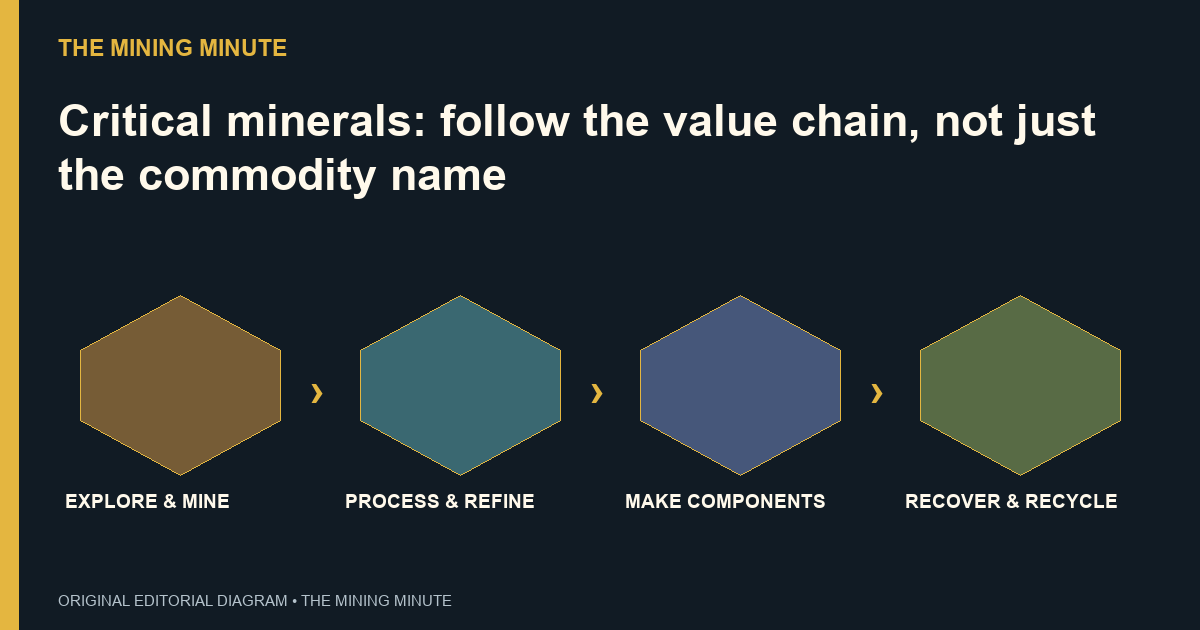
Two announcements can mention the same mineral and describe very different activities. One might concern an early exploration programme; another might describe processing capacity or a proposed customer relationship. Our reading framework starts by locating the announcement in the supply chain. That first step prevents a familiar commodity name from standing in for an explanation of what the business does.
Use the official list as a reference
Canada’s federal critical-minerals overview identifies 34 minerals and metals on the list updated in 2024. The federal strategy discusses a chain extending beyond extraction into processing, manufacturing and recycling. Those references are useful context, but a place on a national list does not demonstrate the quality or commercial readiness of a particular project. We keep the policy description separate from claims made by individual companies.
Build a four-part project description
For our editorial worksheet, describe the input, the activity, the proposed output and the next evidence needed. For example, a processing proposal should explain what material it expects to receive and what it intends to produce. Readers should not have to infer those facts from a battery, wind-turbine or electric-vehicle illustration. If the original source does not identify a specification, customer or operating milestone, record that as an unanswered question.
Check which jurisdiction is being discussed
Federal, provincial and international definitions serve different policy purposes. Québec publishes its own critical and strategic minerals information, including stated uses and its regional context. A useful story names the jurisdiction behind a classification and links to that source. It avoids presenting one government’s terminology as a universal label. This matters when an article compares projects or initiatives across borders.
Do not collapse plans into operating capacity
Our editing rule is to keep verbs precise. Proposed, studied, financed, built and operating are different descriptions. A plan to process material should remain a plan until the supporting source establishes the next stage. The same applies to a partnership announcement: explain the agreement that was announced rather than implying it guarantees sales, production or a finished supply chain. These are editorial distinctions, not forecasts about whether a project will succeed.
A clearer brief for readers and contributors
A good critical-minerals brief tells the reader where the activity sits, why the source considers it relevant and what remains unresolved. Contributors can improve their submissions by supplying the original document, the location, the project stage and an image they have permission to use. Our diagrams explain the reading framework; they are not photographs of a named project. Future news coverage will apply the same structure to dated announcements and will distinguish issuer-funded material from editorial reporting.
Sources and further reading
- Canada’s critical minerals — Government of Canada
- Canadian Critical Minerals Strategy
- Critical and strategic minerals — Québec