 The Mining Minute
Reader guide
Before the headline: a better way to read a mining announcement
A practical newsroom checklist for separating the reported result, the supporting evidence and the work still ahead.
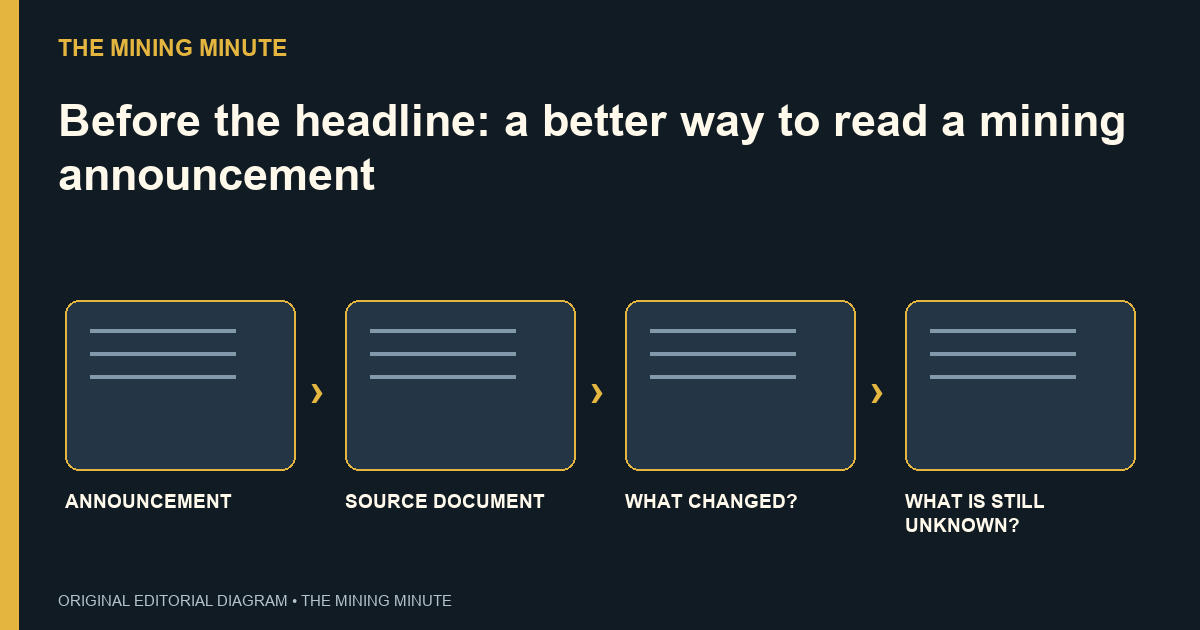
Start with the original document
A mining headline is an invitation to read, rather than a complete account of a project. Our starting point is the issuer’s original release and the technical document it cites. Save the publication date, project name and original link before comparing the announcement with an older story. This creates a usable record of what the company actually reported, instead of a chain of repeated headlines. A short article should help a reader find that record quickly.
Separate the result from the interpretation
Write down the reported observation in one sentence. Then write a separate sentence describing management’s interpretation. If those sentences sound identical, look again for assumptions. A sample, an exploration target and a proposed next step answer different questions. Our editorial approach is to preserve the company’s stated units, location and limitations, attribute its claims, and explain what new evidence would make the interpretation more useful.
Read the supporting context
Canadian mineral-project disclosure uses a specialist reporting framework. The published NI 43-101 instrument addresses scientific and technical information, qualified persons and technical reports. That makes the report and its responsible authors useful starting points for readers checking an announcement. A newsroom summary does not replace the technical report or establish that a regulator has endorsed a project. Where a release points to a report, we want the report link beside the summary—not buried behind a promotional button.
Ask what actually changed
Our comparison worksheet has four columns: previous statement, new statement, evidence supplied and remaining question. It helps distinguish a genuinely new result from a recap, a change in project ownership or a restatement of an older estimate. A company may have a worthwhile story even when it has not announced a discovery. Readers still need to know whether the change concerns geology, funding, engineering, permissions or communications.
Keep the project stage visible
An exploration update should not read like a production report. Natural Resources Canada describes mineral development as a sequence that can involve exploration, evaluation, construction, operation and eventual closure. Our editorial inference is straightforward: each stage calls for different questions. At an early project, ask what is known and what remains to be investigated. At an operating mine, ask what the latest operational document actually measures. Do not move a project further along that sequence because a headline sounds confident.
What a useful reader takeaway looks like
A strong takeaway identifies the company’s announcement, explains its limited significance and links to the evidence. It also names the next reported milestone without promising that it will happen. When a date or outcome is uncertain, say so. If the only available information is promotional copy, label it as company-supplied material and keep the open questions visible. That is the standard we are building into The Mining Minute’s news desk and contributor review process.
Sources and further reading
- Published NI 43-101 instrument — B.C. Securities Commission
- Mineral exploration and development — Natural Resources Canada