 The Mining Minute
Reader guide
From exploration to closure: where does a mining project stand?
A stage-by-stage reading framework for understanding what a project update establishes—and what it does not.
Put the stage before the headline
A project update is easier to understand when its stage is stated near the top. A geological investigation, a development proposal and a production update should not be treated as interchangeable evidence. Our approach is to identify the activity described in the original source before writing the headline. If the stage is unclear, the story should explain that uncertainty rather than assigning a more advanced label.
Use a lifecycle reference without inventing a timetable
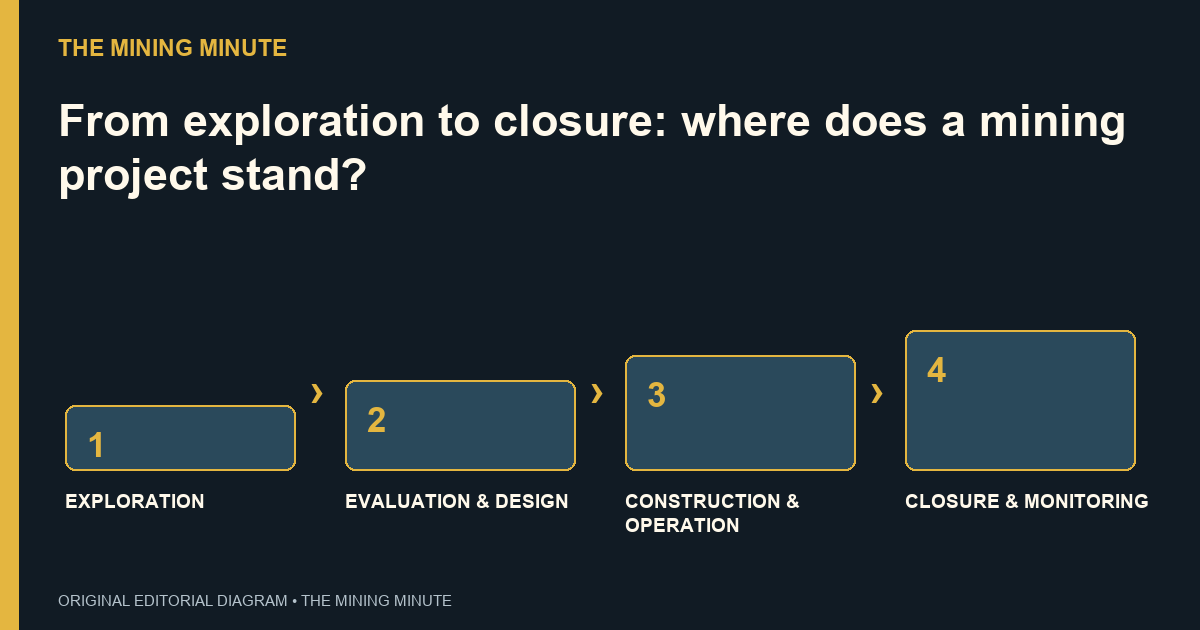
Natural Resources Canada’s public-confidence framework describes pre-exploration, exploration, development, operation and closure. It associates development with work such as design, assessment, approvals and construction; operation concerns extraction and processing. We use that sequence as a map for reading, not as a promised timetable. A diagram cannot establish how long a particular project will take or whether it will reach another stage.
Keep jurisdiction and permissions specific
British Columbia’s mining lifecycle page separately identifies public geoscience, prospecting and tenuring, exploration and discovery, production, and closure. It also identifies reclamation, health and safety, compliance and enforcement as activities across the lifecycle. Ontario describes its own mining sequence and consultation context. Our editorial conclusion is that a story needs the relevant jurisdiction’s language and source, rather than an assumed universal approval process.
Explain the evidence for each claimed milestone
For each update, ask which document establishes the milestone. Is the announcement reporting completed work, a submitted application, a decision, a construction activity or an operational result? Those are different events. Our article template keeps a field for the original document and another for the exact event being described. A proposal should not become an approval during summarising, and an approval should not become a claim that a mine is operating.
Make the next question useful
The next question should follow from the current stage. At exploration, a reader may need to understand the purpose of the next investigation. During development, the useful question may concern the status of a named study or application. During operation, it may concern the period and basis of an operational report. We avoid a generic list of catalysts that turns every update into a prediction of progress.
Carry the full lifecycle into the story
Closure belongs in the project narrative from the beginning rather than appearing only when operations stop. Our reading worksheet therefore includes a place for the source’s environmental, community and closure context. This is not an assessment of a company’s performance; it is a way to make missing context visible. Contributors should link to the underlying project information and describe what it actually establishes. That lets readers follow a project over time without mistaking a series of headlines for a complete record.
Sources and further reading
- Public confidence along the mineral development cycle — NRCan
- Mining life cycle and permitting — British Columbia
- Mining sequence — Ontario