 The Mining Minute
Reader guide
Battery recycling: collected material is not the final recovered product
Follow the steps between collecting a battery and producing a usable recovered material.
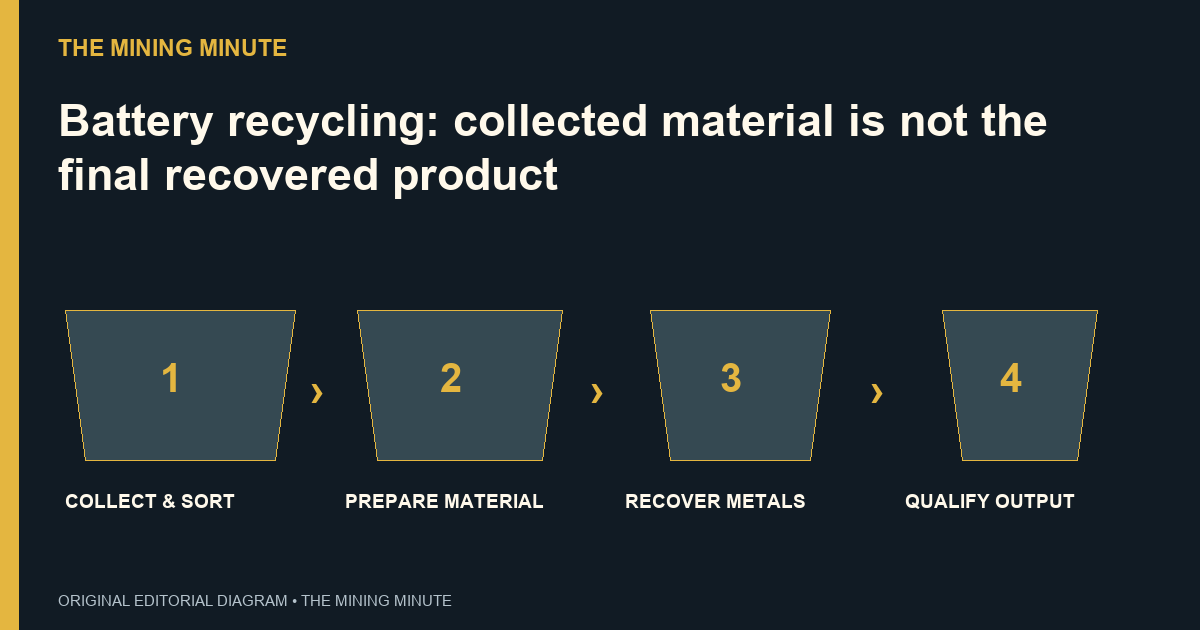
Follow the material through the process
The U.S. Environmental Protection Agency describes battery recycling as a sequence that can include collection, identification and sorting before further processing. Battery chemistries vary. Its overview explains why the material entering the system matters, rather than treating every used battery as an identical feed. We use that sequence as context, not as instructions for handling batteries.
Capacity needs a definition
When a company announces recycling capacity, ask what it can receive and which stage the figure describes. A collection programme, preparation facility and metal-recovery operation should not become the same business activity in a summary. Our editing note records the feed, process, stated output and operating status. If a stage is still planned, retain that qualification.
Read the output claim carefully
A claim about recovered material should identify the material and specification the source actually reports. Do not infer finished battery chemicals from the fact that a feed contains valuable metals. Where the company discusses a future customer, read the announced agreement and its conditions. A supply-chain graphic can explain an ambition without proving that every commercial step is established.
The question worth revisiting
What evidence connects incoming material with the output the company says it can produce? That question makes a useful follow-up when a plant starts, expands or changes its feed. This desk will distinguish collection, processing and finished-product milestones, keeping company claims attributed and avoiding unsupported claims of complete recovery or a closed loop.
Sources & footnotes
- Lithium-ion battery recycling — U.S. EPA. Checked 2026-10-24.