 The Mining Minute
Reader guide
Gold demand and mine output: two stories hiding in one headline
A gold-market story becomes clearer when the buyer, the producer and the reporting unit are kept separate.
Gold has more than one audience
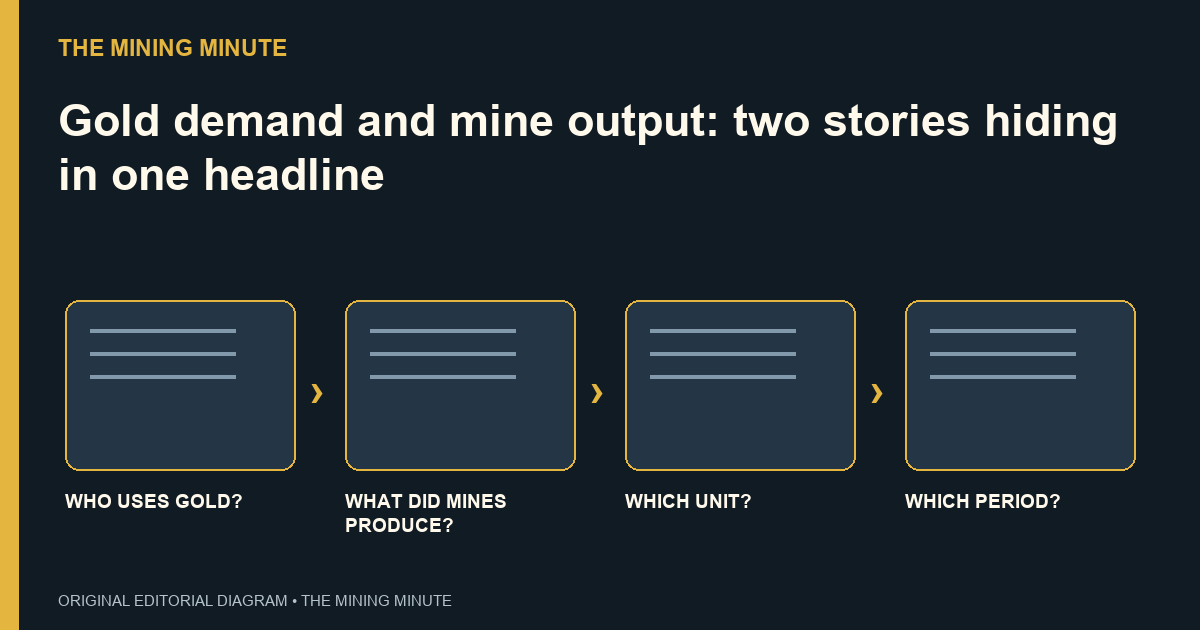
Natural Resources Canada identifies investment and jewellery as familiar uses of gold, alongside electronic and technology applications. Its gold facts page separates demand, mine production, trade and recycling. That structure is useful: a headline about buyers is answering a different question from an operating mine’s quarterly production update. Neither alone explains the financial performance of a specific company.
Follow the unit into the source
Before comparing two numbers, copy the unit and period beside each one. A price quoted per troy ounce is not a mine’s output; tonnes reported for a country are not a company’s attributable ounces. NRCan explains the troy ounce as a precious-metals weight measure. Our reading rule is to retain the original unit and avoid an unexplained conversion that makes a comparison look more precise than it is.
Build a useful company question
For a mine update, ask what changed at the operation and which disclosed factors management gives for that change. For a demand story, ask which buyer group and time period the source describes. Put those questions side by side before suggesting that one caused the other. A stronger gold price does not, by itself, verify a particular mine’s production, costs or delivery against its plans.
The one-minute takeaway
Read gold stories on two tracks: the market using and holding the metal, and the businesses producing it. Then check the connection the source actually supports. Our precious-metals desk will follow both, with dated releases and open questions. This guide supplies context; it does not provide a current gold price or rank gold securities.
Sources & footnotes
- Gold facts — Natural Resources Canada. Checked 2026-10-24.