 The Mining Minute
One-Minute Mining Brief
Saskatchewan potash: the geology behind an agricultural mineral
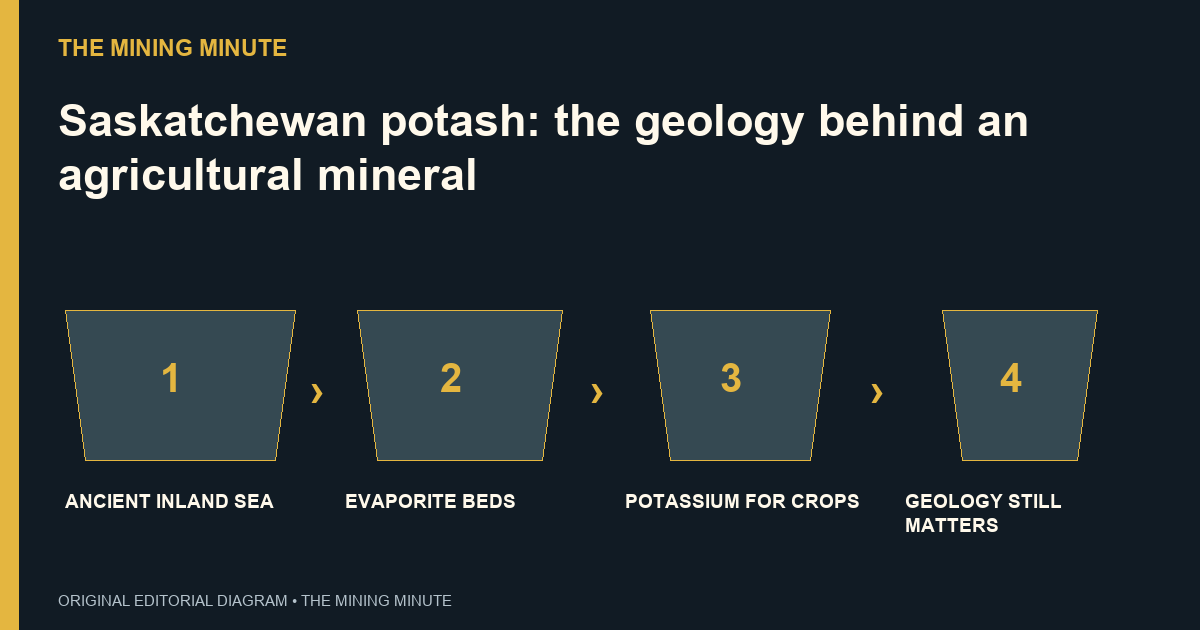
Nutrien’s October 8 geology feature explains how ancient inland seas helped form Saskatchewan’s potash deposits. Repeated evaporation and recharge concentrated minerals over geological time, leaving underground beds now mined for a source of potassium used in crop nutrition.
Nutrien · Original issuer source · Source release: 2026-10-08
What happened
Nutrien’s October 8 geology feature explains how ancient inland seas helped form Saskatchewan’s potash deposits. Repeated evaporation and recharge concentrated minerals over geological time, leaving underground beds now mined for a source of potassium used in crop nutrition. [1]
Why it matters
This provides a foundation for following agricultural minerals beyond fertilizer-price headlines. Deposit geometry, continuity and surrounding rock all influence how an underground operation is understood and planned. A company’s educational feature offers context; it is not a new reserve statement or an independent assessment of a particular mine. [1]
The key number
The source places the geological story roughly 400 million years in the past. That age describes deposit formation, not mine life, current production or the duration of an economically recoverable reserve. [1]
What to watch
The feature describes geologists studying underground conditions and using tools including borehole radar and seismic imaging. When reading a mine update, ask how geological understanding connects to planning, safety and the specific technical evidence supplied. [1]
Sources & footnotes
- Nutrien — original release/feature, 2026-10-08. Checked 2026-10-24.