 The Mining Minute
Reader guide
From a map to a drill result: keep the evidence chain visible
A map, sample and drill announcement become more useful when their purpose and limits are explained.
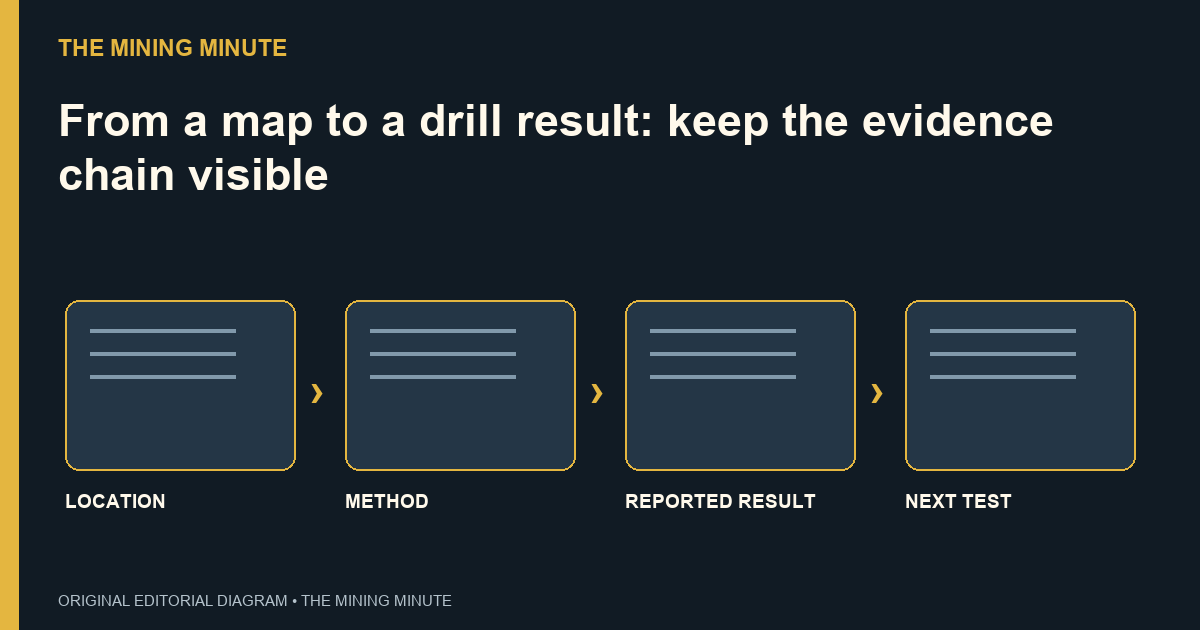
Begin with the question being tested
CIM’s exploration guidance addresses planning, supervising and executing exploration programmes. That emphasis is a useful reminder that exploration is a sequence of work, rather than a single spectacular number. Our reader’s starting point is the stated purpose of the programme: what did the company set out to test, and which part of the new release addresses that purpose?
Read the map as evidence
Ask whether the map gives enough location and scale information to orient a reader. Check its caption, legend and source before treating two marked locations as directly connected. If the release leaves a spatial relationship unclear, preserve that uncertainty. A newsroom diagram can illustrate a concept, but it should never be presented as a surveyed map of a project.
Keep the result in its setting
Record the reported method, unit and limitations alongside the result. Look for the responsible technical authors and the supporting document the company identifies. A short article should help readers reach that evidence rather than replace it. Avoid upgrading a reported observation into a resource, reserve or commercial outcome without the appropriate supporting disclosure.
Ask what comes after the announcement
The next useful question is what work would test the interpretation. The answer might be supplied by the company’s stated programme; if it is not, leave it as a question. Our exploration coverage separates the observation, management’s interpretation and a future plan. That structure lets readers revisit the story when the next piece of evidence arrives.
Sources & footnotes
- CIM Mineral Exploration Best Practice Guidelines overview. Checked 2026-10-24.